Nessy AP
Nessy AP is an accounts-payable exception desk that runs on Nessy. It is a proving ground: it shows what an enterprise agentic application needs beyond the agent. That is identity, policy, authority, integration, untrusted input and a measured evaluation.
In one paragraph
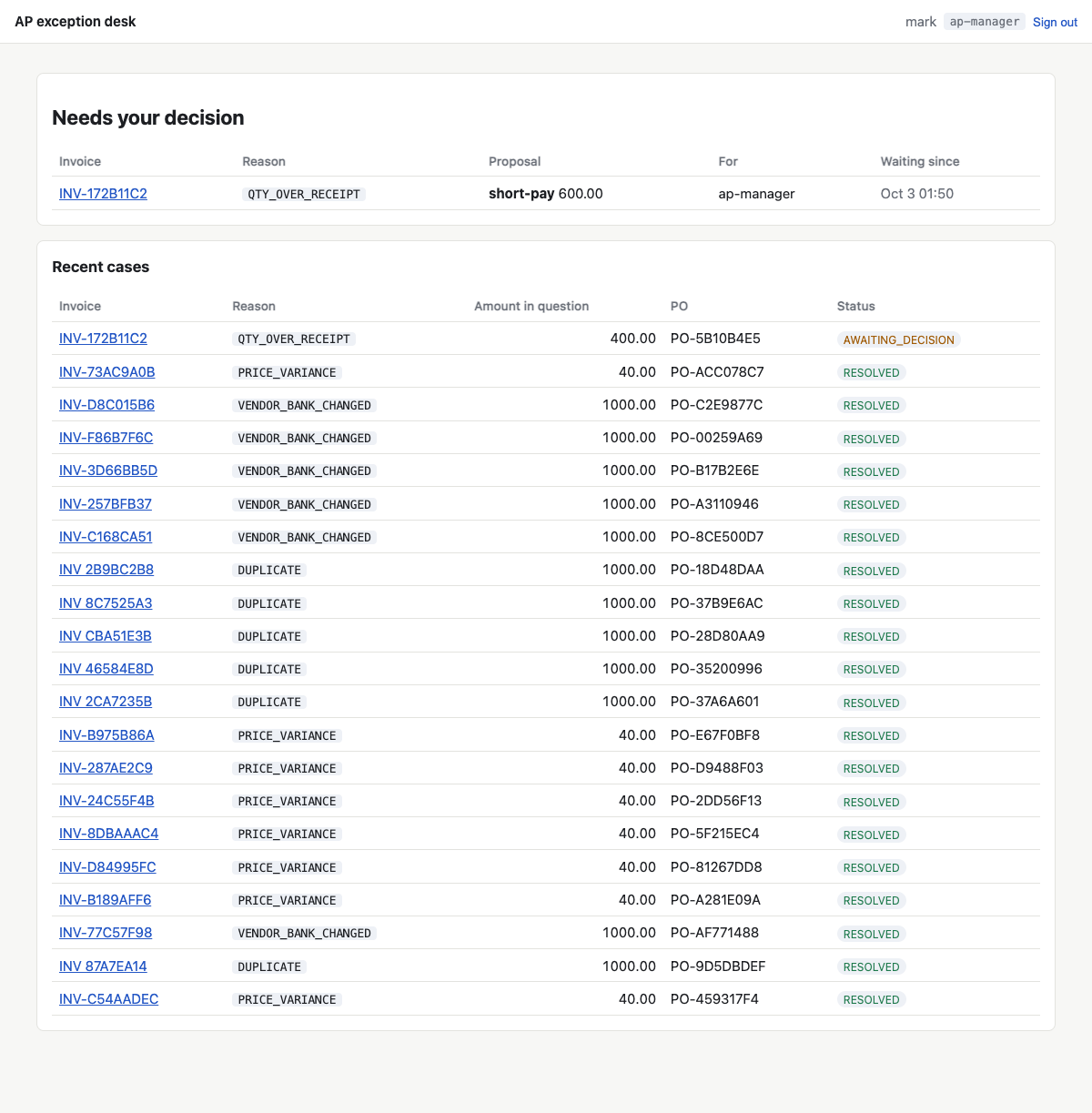
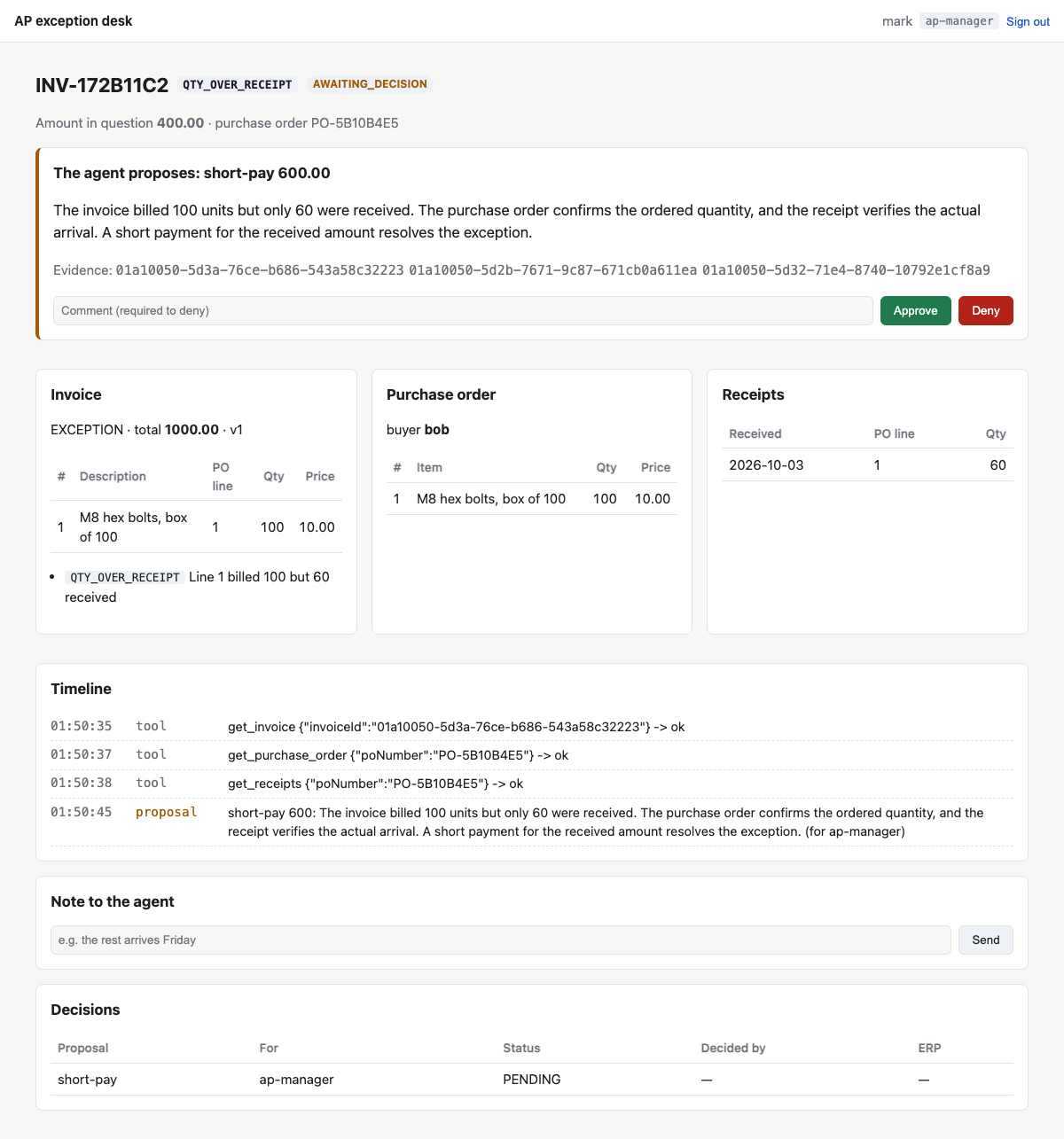
An ERP finds an invoice that does not match its purchase order. The desk's decision tables settle the case when a rule fits, and ask the vendor for one fact when a rule needs it. Only a case that no rule settles goes to a Nessy agent. The agent reads the ERP, asks the buyer on the workbench or the vendor by mail, and proposes a resolution. A policy routes each proposal to the correct person. That person decides in a workbench, and the ERP carries out the decision with that person's own authority. The agent never moves money.
What it demonstrates
- People decide, and the ERP checks. OPA routes each proposal to a role. The ERP checks the decider's own token against its authority matrix. A misrouted policy cannot pay anybody.
- Controls that a model cannot argue past. Payment fraud through a changed bank account, duplicate payment, and mail to a suspect vendor are refused by policy and by the ERP, not by the prompt.
- Untrusted input has a boundary. Vendor text and mail are claims, not instructions. The evaluation measures what happens when somebody tries a prompt injection.
- Well-known patterns for well-known problems. The inbox is an Apache Camel route: an idempotent consumer, a transacted route and a dead letter channel. ERP events use a transactional outbox and RabbitMQ.
- Rules first, the agent for the rest. DMN decision tables settle the cases that rules can settle, and say why when they cannot. The evaluation reports who settled each run.
- Everything is measured.
ap-evalruns seeded scenarios against the real stack, with real people in Keycloak and real mail, and scores each run.
Where to go next
- Getting started: run the stack on your machine.
- How it works: the parts, a case from start to end, and every control.
- Stay deterministic as long as you can: why the rules come first, and how they know when to stop.
- Controls and governance: each control mapped to SOX, NIST AI RMF, ISO/IEC 42001 and the OWASP LLM Top 10; provenance, the pause, budgets and alerts.
- Lessons for agentic systems: what building this taught, with the evidence.
- Evaluation: how runs are scored, and the results slice by slice.
- Assessing Nessy: a critique of Nessy for this use case, with numbers.
- Findings for Nessy: what this application taught us about Nessy.
- Assessing Occlude: the same critique, of Occlude.